Common Gym Injuries: How to Train Smarter and Stay Injury-Free
You finally get into a good workout rhythm.
You’re lifting consistently. You’re pushing heavier weights. You’re feeling stronger, more confident, and motivated.
Then out of nowhere, something starts to feel “off.”
A shoulder pinches during bench press. Your low back tightens after deadlifts. Your knee starts aching after squats or lunges. Your elbow gets irritated every time you pull, press, or grip.
At first, it feels like something you can ignore. But over time, the pain starts changing how you train.
You avoid certain exercises. You lower the weight. You skip workouts. Eventually, the gym becomes frustrating instead of energizing.
The good news? Most gym-related injuries are preventable when you understand what your body is trying to tell you.
At Bridge Rehab & Performance, we help active adults, athletes, and busy professionals in Westlake and across Greater Cleveland recover from pain, fix the root cause, and get back to training with confidence.
Here are the most common gym injuries we see, why they happen, and how to stay ahead of them.
Bridge R&P approach: Ease pain, restore proper movement, rebuild strength, and help you keep training for the long haul.
Why Gym Injuries Happen
Most workout injuries do not happen because one exercise is “bad.”
Squats are not bad. Deadlifts are not bad. Bench press is not bad. Running, jumping, lunging, and lifting heavy are not bad.
The problem usually comes from a mismatch between what your body can currently handle and what you are asking it to do.
Common causes include:
Increasing weight, reps, or workout frequency too quickly
Poor warm-up habits
Limited mobility in the hips, ankles, shoulders, or upper back
Weakness or poor control in stabilizing muscles
Repeating the same movement patterns without enough variation
Training through pain for too long
Not recovering well between workouts
The goal is not to avoid hard training. The goal is to build the capacity to handle hard training.
That is where the right combination of performance-based physical therapy, corrective exercise, soft tissue care, and smarter programming can make a huge difference.
1. Shoulder Pain From Pressing or Pulling
Shoulder pain is one of the most common issues we see in people who lift consistently.
It often shows up during bench press, push-ups, overhead press, pull-ups, rows, dips, or lateral raises.
The pain may feel like pinching in the front of the shoulder, tightness near the upper trap, aching deep in the joint, or discomfort when reaching overhead.
A lot of shoulder pain in the gym comes from a combination of limited shoulder mobility, poor shoulder blade control, weak rotator cuff muscles, and too much pressing volume without enough recovery.
The mistake many people make is resting until the pain calms down, then going right back to the same workouts that caused the issue.
At Bridge, we look at shoulder mobility, rib cage position, upper back mobility, shoulder blade control, pressing technique, and total training volume.
From there, we can use targeted manual therapy, dry needling, cupping, scraping, Active Release Technique, and corrective exercises to help calm symptoms while rebuilding better mechanics.
If your shoulder feels stiff, tight, or irritated but you are not dealing with a major injury, a Signature Tune-Up can be a great place to start.
2. Low Back Pain From Squats, Deadlifts, or Heavy Lifting
Low back pain can be frustrating because it makes almost everything feel harder.
Deadlifts, squats, kettlebell swings, rows, RDLs, and even basic core work can start to feel threatening when your back is irritated.
But low back pain does not always mean your spine is damaged.
In many gym-related cases, back pain is connected to poor hip mobility, limited ankle mobility, weak trunk control, overextending the low back during lifts, fatigue-related form breakdown, or loading too aggressively after time off.
The key is not always to stop lifting completely. The key is to modify the right variables.
That may mean changing the range of motion, adjusting the tempo, using a trap bar instead of a straight bar, switching from back squats to goblet squats, or rebuilding your hinge pattern before returning to heavier deadlifts.
Our physical therapy approach is built around helping you keep moving while we address the root cause.
We do not want you stuck in the cycle of resting, feeling better, returning to the gym, and then flaring up again two weeks later. The goal is to get you strong enough that your back is no longer the limiting factor.
3. Knee Pain During Squats, Lunges, Running, or Jumping
Knee pain is another common gym injury, especially for people who do a lot of squats, lunges, running, jumping, HIIT classes, or lower-body training.
It may show up as pain around the kneecap, pain below the kneecap near the patellar tendon, pain on the inside or outside of the knee, stiffness after leg day, discomfort going downstairs, or pain during deep squats and lunges.
In many cases, the knee is not the only problem.
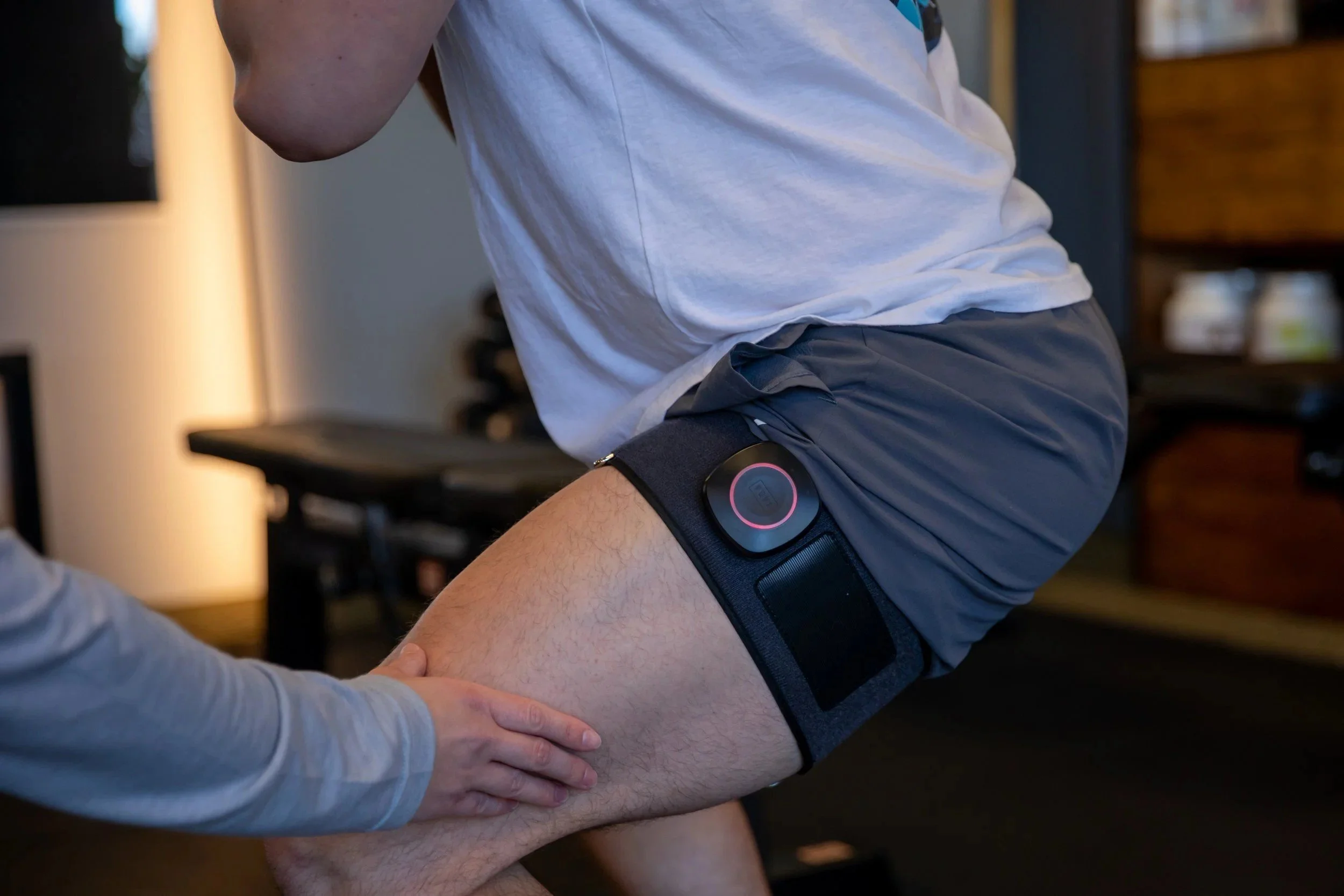
The knee sits between the hip and ankle. If the hip lacks strength or control, or the ankle lacks mobility, the knee often takes extra stress.
That is why simply wearing a knee sleeve or avoiding leg day usually does not solve the problem long-term.
A better plan looks at the full chain:
Hip strength
Glute control
Quad capacity
Ankle mobility
Foot mechanics
Squat and lunge technique
Training volume and recovery
If you are a runner or hybrid athlete, a Running Analysis can also help identify form issues, strength gaps, and workload errors that may be contributing to knee pain.
4. Elbow Pain From Pull-Ups, Curls, Pressing, or Gripping
Elbow pain is common in lifters, golfers, tennis players, pickleball players, CrossFit athletes, and anyone doing a lot of gripping.
It often shows up with pull-ups, chin-ups, curls, bench press, rows, deadlifts, farmer carries, kettlebell work, golf, tennis, or pickleball.
The pain may be on the inside of the elbow, outside of the elbow, or near the forearm.
This is often a tendon capacity issue. In simple terms, the muscles and tendons around the elbow are being asked to handle more load than they are currently prepared for.
Rest may calm symptoms temporarily, but tendons usually need progressive loading to become stronger.
That means the answer is not always to stop training. It is to adjust grip, volume, exercise selection, tempo, and loading strategy so the irritated tissue can adapt.
Our Tune-Up sessions can help reduce tension in the forearm, biceps, triceps, shoulder, and upper back while giving you a more specific plan to keep training without constantly irritating the elbow.
5. Hip Pain and Tightness From Lifting or Sitting All Day
A lot of active adults deal with hip tightness.
Sometimes it feels like a pinch in the front of the hip during squats. Other times it feels like deep glute pain, tight hip flexors, or stiffness after sitting at a desk all day.
The common mistake is stretching the hip flexors over and over without ever addressing why they keep feeling tight.
Sometimes a muscle feels tight because it is weak, overworked, or trying to protect another area that is not doing its job.
A better approach combines mobility work, hands-on treatment, strength training, and movement retraining.
Our personal training program is designed to match your specific sport, fitness goals, body type, and limitations. That makes it a strong option if you want to keep training hard while improving mobility, strength, and performance.
6. Achilles, Calf, and Foot Pain From Running, Jumping, or HIIT
If your workouts include running, sprinting, box jumps, jump rope, sled pushes, or high-intensity classes, your calves and Achilles tendons take a lot of stress.
Common issues include Achilles tendon pain, calf strains, plantar fasciitis, shin splints, foot arch pain, and ankle stiffness.
These injuries often happen when training volume increases faster than the tissue can adapt.
Maybe you added more running. Maybe you started a new class. Maybe you went from lifting three days per week to training six days per week. Maybe you changed shoes or started doing more plyometrics.
Your cardiovascular system may be ready for the workload, but your tendons, calves, feet, and ankles may need more time.
The solution is usually a combination of progressive calf strengthening, ankle mobility work, foot control, load management, and smart return-to-training progressions.
If running is part of your fitness routine, our Running Analysis can help identify the movement and workload factors that may be contributing to the problem.
The Big Mistake: Waiting Until You Are Fully Injured
Most gym injuries start as small warning signs.
A little tightness. A little pinch. A little soreness that does not feel quite normal.
Then people wait.
They work around it. They stretch it randomly. They take a few days off. They try a massage gun. They search YouTube exercises. They keep training until the issue becomes harder to ignore.
By the time they finally get help, they have often changed their workouts for weeks or months.
That is the opposite of what we want.
At Bridge Rehab & Performance, we believe the best time to address pain is before it becomes a major injury.
That is why we offer services like performance-based physical therapy, Signature Tune-Ups, personal training, and sauna + cold plunge recovery to help you stay proactive instead of reactive.
How to Prevent Common Gym Injuries
You do not need a complicated plan to stay healthier in the gym. You need consistency with the basics.
1. Warm Up With Intent
Do not just walk on the treadmill for five minutes and call it a warm-up. Use movements that prepare your body for what you are about to train. Before lower-body days, focus on hips, ankles, glutes, and core activation. Before upper-body days, focus on shoulder mobility, rotator cuff activation, shoulder blade control, and upper-back mobility.
2. Progress Gradually
Strength training works because your body adapts to stress. But too much stress too quickly can cause irritation. Avoid increasing weight, reps, sets, and frequency all at the same time. Change one variable at a time and give your body time to adapt.
3. Do Not Ignore Technique
Technique matters. Not because every rep needs to look perfect, but because better mechanics help distribute stress more evenly across your body. If your squat, deadlift, press, or running form keeps causing pain, it is worth getting assessed.
4. Strengthen the Weak Links
Most people train what they enjoy and avoid what they struggle with. But your weak links eventually show up. For many active adults, that means not enough single-leg strength, core control, shoulder stability, hip mobility, or posterior chain strength.
5. Take Recovery Seriously
Recovery is not a luxury. It is part of training. Sleep, hydration, nutrition, rest days, mobility work, and soft tissue care all matter.
6. Get Help Early
If pain is changing how you move, how you lift, or what exercises you avoid, it is worth getting checked out. The earlier you address the issue, the easier it usually is to fix.
Our sauna and cold plunge options can be a great way to support recovery, reduce soreness, and build a better routine around taking care of your body between workouts.
When Should You See a Physical Therapist?
You should consider seeing a physical therapist if:
Pain lasts more than one to two weeks
Pain gets worse during your workout
Pain changes your form
You feel weaker on one side
You keep dealing with the same recurring issue
You are avoiding exercises you used to enjoy
You feel stuck between resting and re-injuring yourself
You do not need to wait until you are completely sidelined. Our goal is to help you stay active while we fix the root cause.
Your Gym Injury Prevention Checklist
✓ Warm up before every workout
✓ Progress weight, reps, and volume gradually
✓ Strength train through full, controlled ranges of motion
✓ Include single-leg and core stability work
✓ Prioritize mobility where you are limited
✓ Take recovery seriously
✓ Do not train through sharp or worsening pain
✓ Get assessed before a small issue becomes a major injury
Train Hard. Recover Smarter. Stay in the Game.
The goal is not to train less.
The goal is to train smarter, recover better, and build a body that can handle the life you want to live.
At Bridge Rehab & Performance, we help active adults and athletes in Westlake, Ohio move better, recover faster, and stay strong for the long haul.
Whether you are dealing with shoulder pain, knee pain, back tightness, hip stiffness, elbow irritation, or a nagging injury that keeps coming back, we can help you find the root cause and build a plan that actually makes sense for your goals.
SCHEDULE YOUR EVALUATION TODAY
You’ll hear from us in less than 12 hours. | 216-245-3496 | kyle@bridgerandp.com