
By Kyle MacMillan, PT, DPT
Introduction: Are You Training One Leg at a Time?
Think about the last time you went for a run, played pickleball, lifted weights, or pushed through a tough workout. How often were both feet doing the exact same thing at the same time?
Probably not as often as you think.
Running is a series of single-leg movements. Every stride requires one leg to support your body, absorb force, and help propel you forward while the other leg moves through the air. The same idea applies to walking, climbing stairs, jumping, changing direction, and many everyday activities.
Yet, a lot of strength training focuses on exercises that use both legs at once, like traditional squats and deadlifts. These exercises are valuable, but they don't tell the whole story.
Single-leg strength is an important piece of building a stronger, more resilient body. It helps you develop the strength, balance, and control needed to move efficiently, handle the demands of your sport, and keep doing the activities you love.
At Bridge Rehab & Performance in Westlake, Ohio, we look beyond simply getting stronger. We want you to build strength that carries over into your workouts, your sport, and your everyday life.
Let's break down why single-leg strength matters, which exercises can help, and how to start incorporating it into your training.
What Is Single-Leg Strength?
Single-leg strength is your ability to produce and control force while relying primarily on one leg. This involves more than just how much weight you can lift. It also includes your ability to maintain balance, control your body's position, and move through a range of motion without losing stability.
When you train one leg at a time, you're challenging several components of movement:
Strength: Can your leg generate enough force to push you forward, jump, or climb?
Balance: Can you maintain control while standing or moving on one leg?
Stability: Can your hip, knee, and ankle work together to control your movement?
Coordination: Can you control your body as you shift your weight or change direction?
Mobility: Can your joints move through the range of motion your activity requires?
These qualities work together. Having strong muscles is helpful, but being able to use that strength while balancing and controlling your body is just as important.
Why Single-Leg Strength Matters for Runners
1. Running Is Essentially a Series of Single-Leg Movements
Every time you run, one foot contacts the ground while the opposite leg swings forward. Your stance leg must support your body, manage the forces of landing, and contribute to forward movement.
That means each stride places demands on your hips, knees, ankles, and the muscles surrounding them.
If you want to become a stronger runner, your training should prepare you for those demands. Single-leg exercises help you practice producing force and controlling your body on one leg, making them a useful complement to running itself.
Examples include:
Single-leg Romanian deadlifts
Split squats
Step-ups
Single-leg calf raises
Single-leg bridges
These exercises can help develop the strength and control that support your running mechanics and overall training capacity.
2. Build Strength to Handle the Demands of Every Stride
Running places repeated demands on your lower body. Whether you're training for your first 5K or preparing for a marathon, your body needs to tolerate those demands over time.
Building strength can help you better prepare for the physical demands of running, especially when your program gradually progresses alongside your mileage and workout intensity.
Single-leg training can help address areas that general running mileage alone may not fully develop, including unilateral strength, balance, and control.
The goal isn't to make every stride perfect. It's to build a body that's better prepared to handle the work you're asking it to do.
3. Identify Strength Differences Between Legs
Have you ever noticed that one leg feels stronger than the other? Maybe you can perform more repetitions on one side, balance more easily on one foot, or control a step-down better with one leg.
Some differences between sides are normal. However, substantial or persistent differences can be worth addressing, particularly if they affect your performance or follow an injury.
Bilateral exercises can sometimes make it harder to recognize these differences because both legs contribute to the movement.
Single-leg exercises give you an opportunity to assess each side more independently.
This doesn't mean both legs must perform identically. Instead, it means understanding your current abilities and working toward the strength, control, and capacity your activity requires.
4. Support a More Resilient Running Routine
One of the biggest frustrations for runners is having to cut back on training because something starts hurting.
While no exercise can guarantee injury prevention, a well-designed strength program can help improve physical capacity and prepare your body for the demands of running.
Single-leg training is one way to build that capacity.
Combined with appropriate mileage progression, recovery, mobility work when needed, and sufficient rest, it can be a valuable part of a long-term running plan.
If pain keeps returning or you're struggling to increase your mileage, a personalized assessment may help identify what needs attention. Bridge's Running Analysis and Physical Therapy services can help you better understand your movement and develop a plan based on your goals.
Why Single-Leg Strength Matters for Athletes
Running is an obvious example of single-leg movement, but this type of strength training isn't just for runners.
Many sports require you to accelerate, decelerate, jump, land, pivot, and change direction quickly. Those movements place changing demands on each leg.
Whether you play basketball, soccer, tennis, pickleball, or another recreational sport, single-leg strength can help you prepare for the movements your sport requires.
1. Improve Control When Changing Direction
Think about moving laterally to reach a pickleball shot or planting one foot to change direction on a soccer field.
Your body needs to control its position while one leg helps absorb and redirect force.
Single-leg exercises can help develop the strength and control needed for these movements. They can also expose areas where you may need additional work before progressing to more demanding athletic drills.
2. Develop Strength for Jumping and Landing
Jumping is only half the equation. Landing requires your body to absorb force and control movement.
Depending on the sport, you may land on one foot, transition onto one leg, or need to stabilize quickly before your next movement.
Exercises such as step-downs, split squats, and single-leg calf raises can help build a foundation for more demanding jumping and landing drills.
As your strength and control improve, your training can progress toward movements that more closely match your sport.
3. Build Confidence After an Injury
Returning to sports after an ankle sprain, knee injury, or other lower-body issue can feel frustrating. You may be able to walk comfortably or perform a regular squat but still feel hesitant when running, jumping, or cutting.
That's because returning to sport requires more than being able to perform basic movements without pain.
Depending on your injury and goals, rehabilitation may involve rebuilding single-leg strength, balance, coordination, and the ability to tolerate sport-specific forces.
A progressive return-to-sport plan helps you work toward the demands of your activity rather than relying on time alone to determine when you're ready.
If you've been dealing with recurring symptoms or aren't sure whether you're ready to return to training, a Physical Therapy Evaluation at Bridge can help establish where you are and what steps may be appropriate.
The Connection Between Your Hips, Knees, and Ankles
Single-leg strength isn't just about one muscle or one joint. Your entire lower body needs to work together.
Your Hips
Your glutes and other hip muscles help produce force and control your pelvis and thigh during single-leg movements.
Hip strength is important for running, stepping, balancing, and changing direction. Exercises such as split squats, single-leg bridges, and single-leg Romanian deadlifts can help develop this strength.
Your Knees
Your quadriceps, hamstrings, and other surrounding muscles contribute to controlling knee movement and producing force.
Single-leg exercises allow you to work on knee control under load while gradually building strength through a comfortable range of motion.
Your Ankles and Calves
Your ankle and calf muscles play an important role in balance, force production, and forward movement.
For runners especially, calf strength and endurance help support the repeated demands of running. Single-leg calf raises are a simple way to train each side independently.
Why the Whole System Matters
A limitation in one area can influence how you perform a movement, but it doesn't automatically mean that one weak muscle is causing your pain.
The goal is to understand how your strength, mobility, coordination, and training demands work together.
That's why a whole-body approach to movement and rehabilitation can be more useful than focusing on a single joint in isolation.
5 Single-Leg Exercises to Add to Your Training
You don't need an elaborate program to begin developing single-leg strength. Start with a few foundational movements, focus on good control, and gradually increase the challenge as your ability improves.
The following exercises are useful options for many healthy, active adults. Choose variations that match your current strength, mobility, and experience.
1. Split Squats
Best for: Hip and leg strength
A split squat places one foot forward and the other behind you, allowing you to lower and raise your body while emphasizing the front leg.
How to do it:
1. Stand in a staggered stance with your feet comfortably separated.
2. Bend both knees and lower your body in a controlled manner.
3. Keep your front foot planted and maintain a comfortable torso position.
4. Push through your front foot to return to standing.
5. Complete your repetitions, then switch sides.
Training tip: Start with body weight before adding dumbbells. Adjust your stance and depth to a range of motion you can control comfortably.
2. Single-Leg Romanian Deadlifts
Best for: Glute, hamstring, and balance training
This exercise challenges the muscles along the back of your hip and thigh while requiring you to maintain balance on one leg.
How to do it:
1. Stand on one leg with a slight bend in your knee.
2. Hinge at your hips as your free leg moves behind you.
3. Keep your torso and back leg moving together as you lower.
4. Stop at a depth you can control without losing balance or position.
5. Return to standing by driving your hips forward.
Training tip: Use a wall or stable support for balance if needed. You can build strength without making balance the hardest part of the exercise.
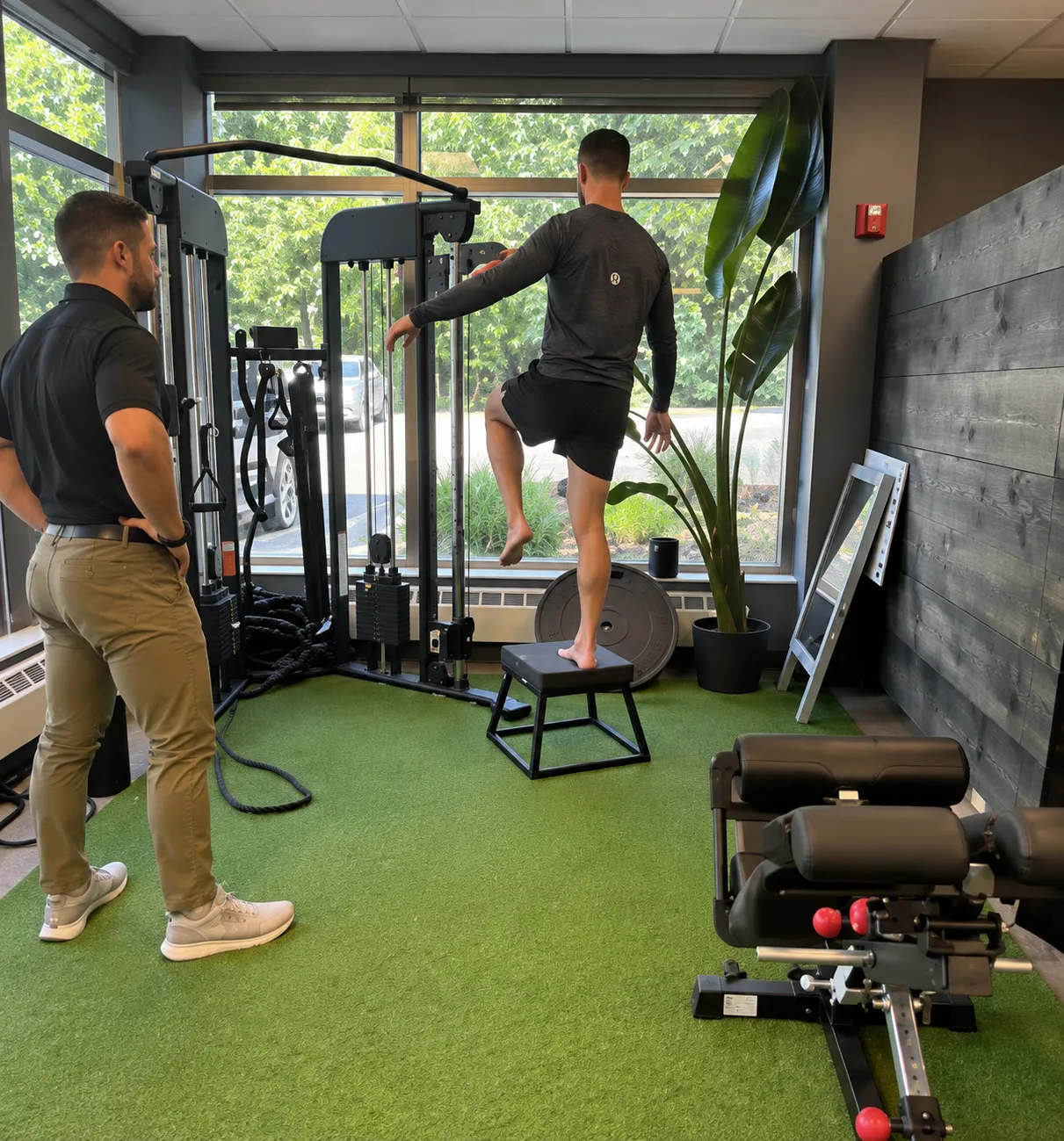
3. Step-Ups
Best for: Functional leg strength
Step-ups train you to produce force through one leg while moving your body onto an elevated surface.
How to do it:
1. Stand in front of a stable step or platform.
2. Place one foot fully on the step.
3. Push through that leg to raise your body.
4. Stand tall at the top without forcefully pushing off the trailing leg.
5. Step down with control and repeat.
Training tip: Begin with a lower step. Increase the height or add resistance only when you can maintain control throughout the movement.
4. Single-Leg Calf Raises
Best for: Calf strength and ankle function
Your calves contribute to walking, running, jumping, and pushing off the ground. Training them one side at a time helps you build strength and endurance independently.
How to do it:
1. Stand on one foot near a wall or sturdy support.
2. Raise your heel as high as you comfortably can.
3. Pause briefly at the top.
4. Lower slowly until your heel returns to its starting position.
5. Repeat, then switch legs.
Training tip: Prioritize a controlled, consistent range of motion rather than bouncing through repetitions. If you have Achilles or foot pain, choose an appropriate variation with guidance from a qualified professional.
5. Single-Leg Glute Bridges
Best for: Glute strength and hip control
Single-leg glute bridges challenge your glutes and require you to keep your pelvis controlled as you lift.
How to do it:
1. Lie on your back with your knees bent and feet on the floor.
2. Lift one foot off the floor.
3. Press through the planted foot and raise your hips.
4. Keep your pelvis level without arching excessively through your lower back.
5. Lower slowly and repeat before switching sides.
Training tip: Start with regular glute bridges if the single-leg version causes cramping, discomfort, or difficulty controlling your pelvis.
How Often Should You Train Single-Leg Strength?
The right amount depends on your training history, current workload, and goals. You don't need to add a separate workout every day to see the value of single-leg training.
For many healthy adults, one to two sessions per week is a reasonable starting point, depending on their existing strength program and recovery needs.
Here is a simple example of how you could get started.
A Beginner-Friendly Starting Point
Choose two or three exercises from the list above.
Perform 2–3 sets per exercise.
Start with approximately 6–10 controlled repetitions per side for strength exercises.
For single-leg calf raises, choose a repetition range that allows you to maintain good control.
Rest as needed between sets.
Begin with body weight or light resistance and progress gradually.
These are general starting guidelines, not a personalized prescription. Your appropriate training volume may differ depending on your experience, symptoms, and other workouts.
Focus on Quality Before Quantity
More repetitions aren't always better.
Pay attention to whether you can maintain control, use a consistent range of motion, and complete each repetition without compensating excessively.
If an exercise feels too difficult, try:
Using a wall or stable support for balance.
Reducing the depth of the movement.
Lowering the step height.
Reducing resistance.
Returning to a two-leg variation until you build more capacity.
Once an exercise feels controlled and manageable, you can gradually increase repetitions, resistance, or complexity.
Balance Strength Training With Your Sport
Runners and athletes need to consider their overall workload.
If you're increasing mileage, preparing for a race, or playing multiple games each week, adding too much strength work at once can leave you overly fatigued.
Plan your strength sessions around your key workouts and give yourself time to adapt. If you're unsure how to balance running, lifting, and recovery, Bridge's Personal Training services can help you work toward a more structured training plan.
Common Single-Leg Training Mistakes to Avoid
Single-leg exercises can be challenging, especially when you're first learning them. A few adjustments can make your training more productive.
1. Progressing too quickly. Adding weight, height, or difficulty before you can control the movement can make it harder to maintain good technique. Build gradually.
2. Ignoring one side. If one leg feels weaker, don't automatically add excessive work to that side. First, understand the difference and adjust your program appropriately.
3. Treating balance as the only goal. Wobbling through every repetition doesn't necessarily build the strength you need. Use support when necessary so you can focus on the intended movement.
4. Pushing through pain. Muscle effort and mild fatigue can be normal, but sharp, worsening, or persistent joint pain deserves attention. Modify the exercise or stop and seek guidance when appropriate.
5. Forgetting the rest of your training. Single-leg exercises are valuable, but they don't replace all bilateral strength work, sport-specific practice, adequate recovery, or a well-planned training schedule.
The goal is to build a balanced program that prepares you for the activities you want to keep doing.
When Should You Work With a Physical Therapist?
You don't need to be injured to benefit from a professional assessment. Sometimes the best time to evaluate your movement is before a small limitation becomes a bigger obstacle to your training.
Working with a physical therapist may be helpful if:
You experience recurring hip, knee, ankle, or foot pain.
One leg consistently feels weaker or less controlled than the other.
You're returning to running or sports after an injury.
You struggle with single-leg movements despite consistent training.
You're increasing your mileage or training intensity and want help managing your workload.
You feel stuck between resting because of discomfort and pushing through it.
A physical therapist can assess your strength, mobility, balance, movement patterns, and training demands to help determine which areas deserve attention.
At Bridge Rehab & Performance, our approach is centered on helping active people understand what is limiting them and build a plan that supports their goals.
Depending on your needs, that may include a Physical Therapy Evaluation, a Signature Tune-Up, or a Running Analysis.
If you're looking to improve your training routine, Personal Training can also help you build strength with a plan that fits your goals.
And because progress depends on more than just the work you do in the gym, Bridge also offers sauna and cold plunge services as part of a broader recovery routine. These services can complement your training, but they don't replace appropriate rest, nutrition, or injury-specific rehabilitation.
The Bottom Line: Train for the Movements You Want to Keep Doing
You don't need to be a competitive athlete to benefit from single-leg strength.
Whether you run several miles a week, lift weights, play recreational sports, or simply want to keep moving comfortably as you get older, building strength and control on one leg at a time can be a valuable part of your routine.
Start with exercises you can perform comfortably. Focus on quality and consistency. Progress gradually. And remember that the best training plan is one that prepares you for the activities that matter most to you.
Don't wait until pain or an injury forces you to rethink your routine. Building strength now can help you prepare for the demands of tomorrow.
At Bridge Rehab & Performance, we help active adults and athletes in Westlake and Greater Cleveland build strength, move with confidence, and keep doing what they love.
Ready to Build Stronger, More Resilient Legs?
Whether you're working toward a new running goal, trying to improve your athletic performance, or looking to address a lingering issue, we're here to help you figure out your next step.
Schedule a physical therapy evaluation, book a Signature Tune-Up, or explore our running analysis and personal training services to find the right fit for your goals.
Schedule your evaluation or contact Bridge Rehab & Performance. Learn more about our services at Bridge Rehab & Performance.
Want help applying this to your body and goals?
Start with a free 15-minute strategy call with Bridge Rehab & Performance in Westlake.
Book Strategy Call